EN
 ES
 AR
 RU


Why is the coating result still unsatisfactory even though the material passes the sieve test?
During the production and final quality inspection of powder coatings, quality control personnel often encounter a puzzling issue: two batches of powder may show identical R45 sieve residue data, yet downstream customers report that one of them exhibits poor leveling, low transfer efficiency, and even the "orange peel" effect.
This is because traditional sieving methods (such as measuring the residue on a 45μm sieve) only provide a single-point cutoff, failing to capture the full particle size distribution within the critical 1–100μm range—a range that fundamentally determines coating quality. With the impending implementation of GB/T 21782.13-2026 (which adopts ISO 13320), the shift toward full-distribution characterization using laser diffraction particle size analyzers has become an irreversible trend. In practice, however, many companies struggle to decide whether to employ dry or wet dispersion methods.
I. Laser Diffraction Method: The Necessity of Obtaining a Complete Particle Size Distribution Curve
Laser particle size analyzers are based on Mie scattering theory; they calculate particle size by measuring the angle and intensity of light scattered by the particles. In the case of powder coatings:
II. Powder Coatings: A Face-off Between Dry and Wet Methods — Aerodynamics vs. Liquid-Phase Depolymerization
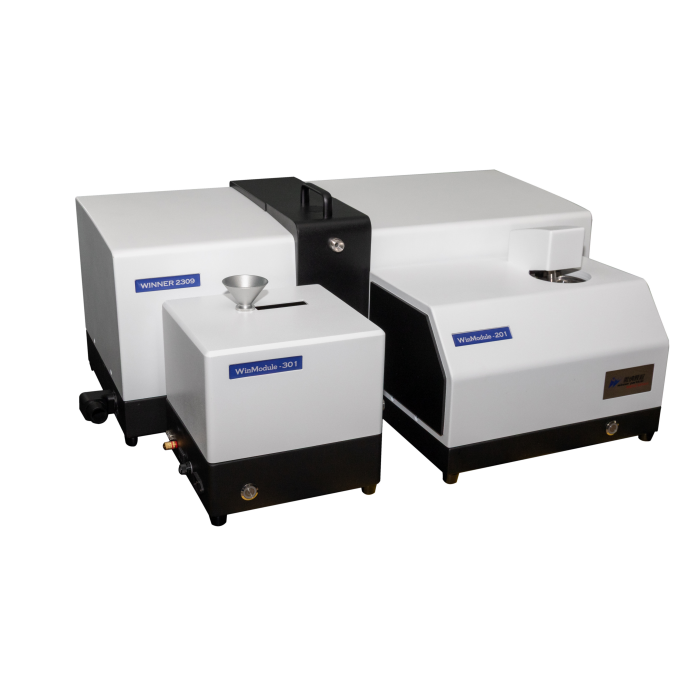
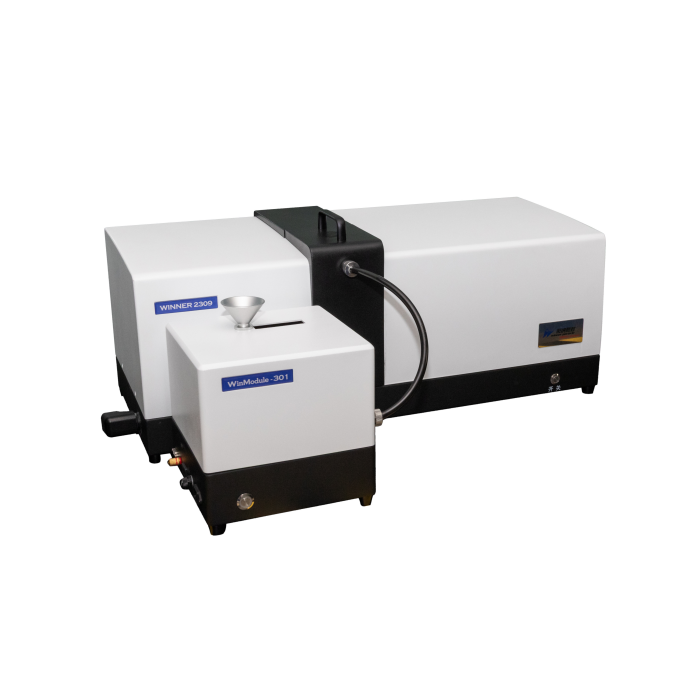
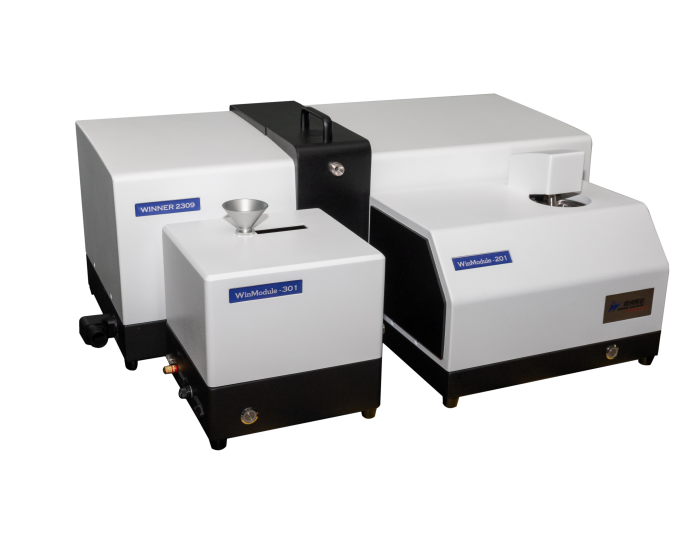
Dry dispersion: Utilizing compressed air as the medium and the principle of turbulent dispersion, this method breaks up powder agglomerates and automatically delivers them into the optical path. The Winner2309A dry-method module (WinModule-301) supports automatic sample feeding and one-touch testing. The dispersion pressure can be adjusted based on the specific characteristics of the sample, ensuring effective deagglomeration while minimizing the risk of secondary particle breakage.
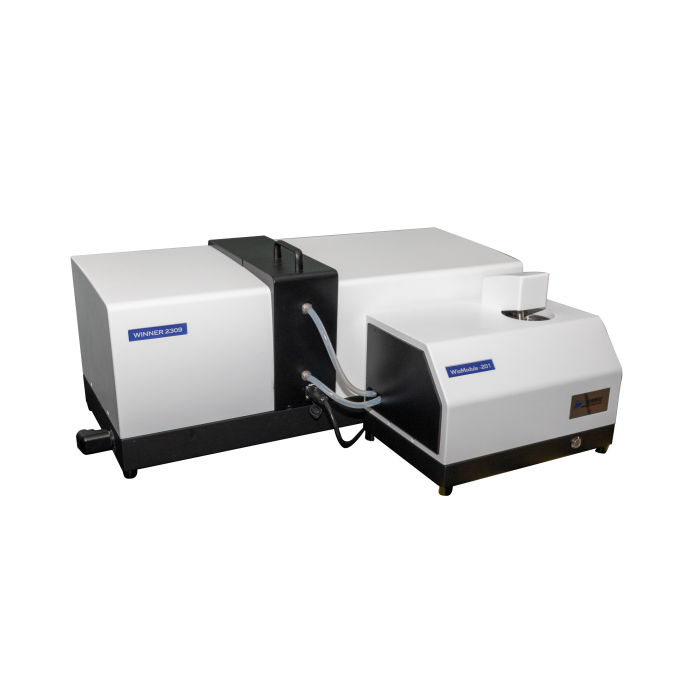
Wet dispersion: The sample is introduced into a dispersion medium, such as water or ethanol. Deagglomeration and uniform dispersion are achieved through the use of ultrasonication (40 kHz, adjustable up to 60 W), mechanical stirring (adjustable from 0 to 3000 rpm), and an integrated circulation pump. The wet-method module for the Winner2309A (WinModule-201) features a 600 ml sample reservoir and supports a fully automated, one-touch process encompassing water filling, bubble removal, dispersion, testing, cleaning, and data processing.
III. Selection Guide: Should You Choose the Dry or Wet Method for Powder Coating Testing?
1. For the vast majority of ready-made powder coatings: the dry method is the preferred choice.
Powder coatings are synthesized and processed in a dry state; therefore, dry-method testing not only aligns more closely with actual production processes but also avoids the risks of swelling or leaching that may occur if the powder comes into contact with water. Industry consensus and research from various institutions indicate that for conventional powder coatings—such as those based on polyester or epoxy resins—dry-method testing yields data that is both highly representative and reproducible, making it an ideal choice for rapid spot-checking and product release on the production line.
2. R&D and Analysis of Special Materials: The Complementary Role of Wet-Chemical Methods
In certain specific cases, the wet method remains necessary. For instance, it is required when a powder coating contains highly fragile fillers that might be broken apart by the high-pressure airflow used in the dry method, or when R&D departments need to determine the primary particle size of raw materials (such as titanium dioxide) within a liquid phase. Furthermore, experimental data indicate that for hydrophilic fillers like talc, the wet method can yield excellent results even without the use of surfactants. Conversely, for lightweight, conductive fillers such as graphene, the dry method must be employed; using the wet method would cause the material to float on the surface of the liquid, leading to significant data inaccuracies.
IV. Repeatability Challenges and Instrument Configuration under the New National Standards
The GB/T 21782.13 standard specifies requirements for the repeatability of particle size testing for powder coatings: the deviation between two test results for any given particle size fraction must not exceed 1%.
This places rigorous demands on the hardware and level of automation of the instruments. In dry-method testing, excessive dispersion pressure can cause secondary fracturing of resin particles, while insufficient pressure fails to break up agglomerates; in wet-method testing, ultrasonic duration and stirring speed must be precisely controlled. A single manual error can lead to a significant decline in repeatability.
V. How does the Winner2309A achieve "all-in-one" versatility?
For powder coating companies, laboratories often need to test both incoming raw materials (such as titanium dioxide or barium sulfate) and finished powder coatings. This entails developing wet-method testing protocols for R&D purposes, while simultaneously conducting rapid dry-method screening on the production line. Purchasing separate instruments for dry and wet testing is not only costly and space-intensive, but it also makes comparing data between the two methods extremely cumbersome.
The Winner2309A—a wide-range, dual-purpose (dry/wet) laser particle size analyzer from Winner—is a perfect fit for this scenario:
VI.FAQ
Q1:When testing the drying method, is the dispersion power setting somewhat suitable?
If the construction is low (0.1-0.2 MPa), the power will be titrated as it starts, and the power will be increased and changed immediately if it is not observed. The power of the power is large, the size of the fat bowl is large, and the power is small and the power is small. Karusuke Winner2309A's SOP Fully Automatic Model Rotation Completion Level Comparison.
Q2:After implementing the new country's title, do you require that the equipment be fully functional?
Must meet ISO 13320 frame and weight deviation ≤ 1% Ready for use. The output of young and old equipment remains unchanged, and the ability to improve the quality of the equipment (such as Winner2309A) greatly improves the quality of the equipment.
Q3:Removed powdered medicine, 2309A Can you use other medicine forms?
OK. It is designed to be integrated into dry and wet powder, as well as aqueous emulsion, color filler and graphite powder, etc. (quantity range: wet method 0.01-3500μm / dry method 0.1-3000μm).
Direitos autorais © Jinan Winner Particle Instrument Stock Co., Ltd. Todos os direitos reservados | Sitemap
Palavras-chave:
Analisador de Tamanho de Partículas a Laser Analisador de Tamanho de Partículas de Spray